
Safeguarding and Child Protection Policy
How we keep children, young people and adults at risk safe, who to contact, and what every member of staff, volunteer and trustee must do when they have a concern.
- Version
- 5.0 · September 2026
- Policy year
- 2026–27
- Next review
- September 2027
- Approved by
- Education & Safeguarding Committee, on behalf of the Board of Trustees
Contents
- Important contacts
- 1Aims
- 2Child protection statement
- 3Legislation and statutory guidance
- 4Policy implementation, monitoring and review
- 5Definitions
- 6Equality statement
- 7Roles and responsibilities
- 8Confidentiality
- 9Recognising abuse and taking action
- 10Online safety and the use of mobile technology
- 11Children with special educational needs, disabilities or health issues
- 12Complaints and concerns about BTC safeguarding policies
- 13Record-keeping
- 14Training
- 15Extended and off-site arrangements
- 16Links with other policies
- App. 1Types of abuse
- App. 2Specific safeguarding issues
- App. 3Supervision of toilets and intimate care
Important contacts
| Role / organisation | Name | Contact details |
|---|---|---|
Designated Safeguarding Lead (DSL) | Mr Vijith Vijay | |
Chair of the Board of Trustees | Kayser Izard | |
Safeguarding Link Trustee | Georgina Pick | |
Newham MASH — children’s social care referrals | (Mon–Thu 09.00–17.15, Fri 09.00–17.00; select option 3 for professional consultation) | |
Newham Emergency Duty Team — out of hours | ||
Newham LADO — allegations about adults who work with children | Alex Mihu (LADO) Evelyn Millyard (Assistant LADO) | 0203 373 6706 (LADO) 0203 373 0751 (Assistant LADO) |
Newham Safeguarding Children Partnership | ||
Newham Adult Social Care — adults at risk | ASCsafeguardingconcerns@newham.gov.uk Out of hours: 020 8430 2000 | |
Police — emergency | 999 | |
Police — non-emergency (including FGM reports) | 101 | |
NSPCC helpline | 0808 800 5000 — (Mon–Fri 10.00–16.00) help@nspcc.org.uk - (11.00–16.00, seven days) | |
Childline | 0800 1111 (24 hours) | |
ACT Early — Prevent advice line | 0800 011 3764 (24 hours) | |
DfE counter-extremism helpline | 020 7340 7264 (Mon–Fri 11.00–15.00) counter.extremism@education.gov.uk report-extremism.education.gov.uk (online form) | |
Disclosure and Barring Service — barring referrals | www.submit-a-barring-referral.service.gov.uk 03000 200 190 (option 2, then 1) | |
Charity Commission — serious incident reporting | ||
Modern Slavery Helpline | ||
NHS — urgent medical help | 111 |
Designated Safeguarding Lead (DSL)
Name
Mr Vijith Vijay
Newham MASH — children’s social care referrals
Contact details
(Mon–Thu 09.00–17.15, Fri 09.00–17.00; select option 3 for professional consultation)
Newham Emergency Duty Team — out of hours
Contact details
Newham LADO — allegations about adults who work with children
Name
Alex Mihu (LADO)
Evelyn Millyard (Assistant LADO)
Newham Safeguarding Children Partnership
Contact details
Newham Adult Social Care — adults at risk
Police — emergency
Contact details
999
Police — non-emergency (including FGM reports)
Contact details
101
NSPCC helpline
Childline
Contact details
0800 1111 (24 hours)
ACT Early — Prevent advice line
Contact details
0800 011 3764 (24 hours)
DfE counter-extremism helpline
Contact details
020 7340 7264 (Mon–Fri 11.00–15.00)
counter.extremism@education.gov.uk
report-extremism.education.gov.uk (online form)
Disclosure and Barring Service — barring referrals
Charity Commission — serious incident reporting
Modern Slavery Helpline
Contact details
NHS — urgent medical help
Contact details
111
Section 1Aims
The purpose of this policy is to ensure that Being The Cure exercises its duty of care to safeguard children, young people, and vulnerable adults. We also have a duty to protect our trustees, staff, volunteers, and programme participants (including children, young people, and vulnerable adults) from any harm that may be caused due to their coming into contact with Being The Cure. This includes harm arising from:
- The conduct of trustees, staff or personnel associated with Being The Cure
- The design and implementation of Being The Cure’s programmes and activities
The policy lays out the commitments made by Being The Cure, and informs trustees, staff, and associated personnel of their responsibilities in relation to safeguarding.
Being the Cure (BTC) aims to ensure that:
- Appropriate action is taken in a timely manner to safeguard and promote children’s welfare
- All staff are aware of their statutory responsibilities with respect to safeguarding
- Staff are properly trained in recognising and reporting safeguarding issues
We recognise that all staff, including volunteers, have a full, equal, and active part to play in protecting children from harm and that everyone at BTC has an objective to keep children and young people safe. Safer children make more successful learners. We recognise that safeguarding incidents can happen anywhere and that children can be harmed anywhere.
All stakeholders need to share and build on existing knowledge and good practice and work together towards ensuring equal protection for disabled children. There is a need to raise awareness about the abuse of disabled children and challenge attitudes and assumptions that act as barriers to protection and to raise disabled children’s awareness of abuse and ability to seek help including access to personal safety skills training.
All trustees/members and staff believe that BTC should provide a caring, positive, safe, and stimulating environment, which promotes the social, physical, and moral development of the individual child. Through its emphasis on prevention and early intervention, this policy aims to minimise the risks of children being abused.
New staff/volunteers will be given a copy of this policy at their induction meeting which is led by the (Designated Safeguarding Lead (DSL) /Child Protection Officer (CPO) – in this document to be known as DSL.
Section 2Child protection statement
We recognise our moral and statutory responsibility to safeguard and promote the welfare of all children. We endeavour to provide a safe and welcoming environment where children are respected and valued. We are alert to the signs of abuse and neglect and follow our procedures to ensure that children receive effective support, protection, and justice.
BTC seeks to provide a safe and secure environment for the children who participate in our programmes and activities. By simply following the practices mentioned in this policy, our goal is to protect the children from incidents of misconduct or inappropriate behaviour.
Being The Cure, for the purposes of this policy and procedures document, considers a Vulnerable Person as anyone who may be restricted in capacity to guard themself against harm or exploitation or to report such harm or exploitation. Restriction of capacity may arise as a result of physical or intellectual impairment. Vulnerability to abuse is influenced by both context and individual circumstances.
Being The Cure, for the purposes of this policy and procedures document, considers a child in line with the United Nations Convention on the Rights of the Child (UNCRC), 1989, under the Policy a child is defined as anyone who has not reached their 18th birthday regardless of whether a nation’s laws recognise adulthood earlier.
Being The Cure is committed to the safeguarding of vulnerable persons and children from abuse. The definitions of safeguarding that guide our work at Being The Cure, are taken from the statutory guidance below:
- Safeguarding children as defined in Working Together to Safeguard Children 2026
- Safeguarding adults at risk as defined in the Care and Support Statutory Guidance issued in the Care Act 2014
Safeguarding means protecting peoples' health, wellbeing, and human rights, and enabling them to live free from harm, abuse, and neglect. It acknowledges that all adults have the right to be safe and to live a life free from abuse. All persons are entitled to this right, regardless of their circumstances. All Being The Cure activities have a publicly declared ‘No Tolerance’ approach to any form of abuse and promotes a culture which supports this ethos.
Being The Cure believes that everyone we come into contact with, regardless of race, colour, sex, language, religion, political or other opinion, national, ethnic, or social origin, property, disability, birth, sexual orientation, gender identity, or other status has the right to be protected from all forms of harm, abuse, neglect, and exploitation.
Being The Cure will not tolerate abuse and exploitation by staff or associated personnel. Being The Cure commits to addressing safeguarding throughout its work. This policy is mandatory and must be applied in all situations where Being The Cure, or our partners, work.
This policy forms part of an employees' terms and conditions of employment and may be subject to change at the discretion of management. It is therefore the responsibility of all staff of Being The Cure to raise any concerns they have or any concerns which are reported to them according to this policy. A core governance responsibility is to ensure that safeguarding policies and procedures and associated practices are in place and appropriate to the activities provided.
Section 3Legislation and statutory guidance
Being The Cure (BTC) is a Charitable Incorporated Organisation, registered charity number 1188077. Much of the statutory safeguarding framework in England is addressed to schools, colleges and registered providers rather than to charities. This section therefore separates three different things: the law that binds BTC directly; statutory and non-statutory guidance that BTC adopts as its benchmark of good practice; and the matters on which BTC holds no statutory duty but has chosen to apply an equivalent standard. Where this policy adopts a standard that is not a legal duty on BTC, it says so.
3.1Legislation that applies directly to Being The Cure
- The Children Act 1989 and the Children Act 2004, which provide the framework for the care and protection of children and, in sections 16E to 16I of the 2004 Act, the multi-agency safeguarding arrangements operated by local safeguarding partners.
- The Safeguarding Vulnerable Groups Act 2006, in particular Part 1 of Schedule 4, which defines regulated activity relating to children, and section 9, which makes it a criminal offence to permit a barred individual to engage in regulated activity. Schedule 4 was amended with effect from 1 September 2026 by section 139 of the Crime and Policing Act 2026 (commenced by S.I. 2026/939, regulation 2), which removed the supervision exemption from the definition of regulated activity.
- The Crime and Policing Act 2026, Part 5, Chapter 2 (sections 85 to 94), which creates a duty to report child sexual abuse. BTC has adopted the duty as policy in advance of commencement (see paragraph 9.7).
- The Equality Act 2010, in particular section 29, which prohibits discrimination by a provider of services to the public whether or not for payment, section 29(7), which applies the duty to make reasonable adjustments to service providers, and section 40A, which requires an employer to take reasonable steps to prevent the sexual harassment of its employees.
- The Health and Safety at Work etc. Act 1974, in particular section 3(1), which requires an employer to conduct its undertaking so as to ensure, so far as is reasonably practicable, that persons who are not its employees are not exposed to risks to their health or safety. This is the provision that covers children, parents, carers and volunteers at BTC activities.
- The Regulatory Reform (Fire Safety) Order 2005, articles 9 and 11, which since 1 October 2023 have required the fire risk assessment and the fire safety arrangements to be recorded in writing irrespective of the number of employees.
- The UK GDPR and the Data Protection Act 2018, as amended by the Data (Use and Access) Act 2025. Section 164A of the 2018 Act, in force from 19 June 2026, requires BTC to facilitate data protection complaints, to acknowledge a complaint within 30 days of receipt, and to respond without undue delay and inform the complainant of the outcome (see paragraph 13.1).
- The Sexual Offences Act 2003, which defines the sexual offences against children that may arise, and under which a person subject to the notification requirements in Part 2 is disqualified from acting as a charity trustee.
- The Human Rights Act 1998.
- The Charities Act 2011, which governs the duties of BTC’s trustees, including the duty to act in the charity’s best interests and to protect its beneficiaries from harm, and which underpins the Charity Commission’s requirement to report serious incidents.
- The Rehabilitation of Offenders Act 1974 and the Exceptions Order 1975 as amended in 2013 and 2020, which govern when criminal record information may be requested and taken into account.
- The Female Genital Mutilation Act 2003, under which FGM is a criminal offence. The scope of the mandatory reporting duty in section 5B is addressed at paragraph 3.3 below.
- The Children’s Wellbeing and Schools Act 2026 (2026 c. 21, Royal Assent 29 April 2026). Section 38 inserts sections 436B to 436G into the Education Act 1996. Section 436E allows a local authority to require a provider of out-of-school education to supply named information about a child, including the child’s name, date of birth and home address and the hours of provision. BTC will comply with such a notice (see paragraph 13.1).
3.2Guidance that Being The Cure follows
- Out-of-school settings: safeguarding guidance for providers (Department for Education, last updated 9 February 2026). This is non-statutory guidance, and it is the external guidance that most closely matches BTC’s activity. It is the primary benchmark for this policy.
- Working together to safeguard children (2026) (HM Government statutory guidance, last updated 18 March 2026).
- Keeping children safe in education (Department for Education, September 2026, in force from 1 September 2026).
- Safeguarding duties for charity trustees (Charity Commission, last updated 1 June 2022), including its ten-point checklist for trustees, and How to report a serious incident in your charity (Charity Commission, last updated 16 January 2026).
- Multi-agency statutory guidance on female genital mutilation (HM Government).
- Sharing nudes and semi-nudes: advice for education settings working with children and young people (UK Council for Internet Safety).
- Information sharing advice for safeguarding practitioners (HM Government).
- The Care Act 2014 and the Care and Support Statutory Guidance, in relation to adults at risk. The duty to make safeguarding enquiries under section 42 of that Act rests with the local authority.
- The Special educational needs and disability code of practice: 0 to 25 years (Department for Education, 2015).
3.3Matters on which Being The Cure holds no statutory duty
- The Prevent duty. Section 26 of the Counter-Terrorism and Security Act 2015 applies only to the specified authorities listed in Schedule 6 to that Act. Charities, voluntary organisations, supplementary schools and unregistered out-of-school settings are not listed, and BTC is therefore not subject to the Prevent duty. BTC nevertheless applies an equivalent standard of vigilance as a matter of policy and of charity-law risk management and will report any concern about extremism or radicalisation connected with the charity to the Charity Commission as a serious incident. See paragraph 9.5.
- The mandatory FGM reporting duty. Section 5B of the Female Genital Mutilation Act 2003 applies to a person working in a regulated profession, which that section defines as a registered healthcare professional, a teacher within the meaning of section 141A of the Education Act 2002, or a social care worker registered in Wales. It does not place a personal statutory duty on BTC staff, volunteers or trustees. BTC requires the same standard of reporting as a matter of policy. See paragraph 9.3.
- The public sector equality duty. Section 149 of the Equality Act 2010 applies to public authorities and to persons exercising public functions. BTC is neither. BTC’s equality duties arise under section 29 (services) and Part 5 (employment) of that Act.
- Section 175 of the Education Act 2002. This places duties on local authorities and on the governing bodies of maintained schools. It does not apply to BTC.
- School and registered-childcare instruments. The School Staffing (England) Regulations 2009, the Education (Independent School Standards) Regulations 2014, the Non-Maintained Special Schools (England) Regulations 2015, the statutory framework for the Early Years Foundation Stage and the Childcare (Disqualification) and Childcare (Early Years Provision Free of Charge) (Extended Entitlement) (Amendment) Regulations 2018 all flow from school status or from Ofsted registration. BTC is neither a school nor a registered provider, so none of them applies to it.
- The Teaching Regulation Agency. The teacher misconduct jurisdiction under section 141A of the Education Act 2002 covers teaching work at schools, sixth form colleges, 16 to 19 academies, relevant youth accommodation and children’s homes in England. A voluntary-sector Saturday school is not within that list. Where an individual concerned also holds or has held a teaching post in one of those settings, a referral to the Teaching Regulation Agency may be appropriate in addition to a referral to the Disclosure and Barring Service.
3.4Local arrangements
BTC delivers its activities in the London Borough of Newham. Its safeguarding practice complies with the published arrangements of the Newham Safeguarding Children Partnership, including the Newham Pathways to Support and Protection threshold guidance, and with the London Child Protection Procedures published by the London Safeguarding Children Partnership at www.londoncp.co.uk.
Section 4Policy implementation, monitoring and review
Responsibility for leading implementation of this policy and procedure rests with Being The Cure’s Operations Team, namely the CEO. The CEO will have overall responsibility for implementation of this policy and procedure within their administrative area, and in collaboration with the DSL will ensure that each manager of relevant Being The Cure activities will undertake the following:
- Communicate this policy to all staff, parents, carers, and volunteers
- Provide appropriate training
- Ensure that service specific procedures are developed, implemented, and reviewed in compliance with this policy
The policy will be monitored, reviewed, and approved by the board of trustees who will work with the CEO and relevant staff wherever necessary to inform the policy and procedures.
This policy will be reviewed annually by the safeguarding link trustee(s). At every review, it will be approved by the Education & Safeguarding committee and reported to the full board of trustees.
Section 5Definitions
Safeguarding and promoting the welfare of children (as defined in UK statutory guidance, Working Together to Safeguard Children, DfE 2026) means:
- Providing help and support to meet the needs of children as soon as problems emerge.
- Protecting children from maltreatment
- Preventing impairment of children’s mental and physical health or development
- Ensuring that children grow up in circumstances consistent with the provision of safe and effective care
- Taking action to enable all children to have the best outcomes
Safeguarding may also refer to the range of proactive measures that BTC has put in place to protect children from potential dangers and risks of exploitation, abuse, and neglect.
Child protection is defined as the activity that is undertaken to protect specific children who are suspected to be suffering, or likely to suffer, significant harm. This includes harm that occurs inside or outside the home, including online. This includes, but is not limited to:
- Neglect
- Physical abuse
- Emotional abuse
- Sexual abuse
- Bullying, including online and prejudice-based bullying
- Racist, disability and homophobic or transphobic abuse
- Gender based violence/violence against women and girls
- Radicalisation and/ or extremist behaviour
- Honour Based Abuse
- Child Sexual Exploitation and trafficking
- Child on Child abuse
- Teenage relationship abuse
- Substance abuse
- Gang/youth violence including initiation/hazing
- Domestic abuse/violence
- Female Genital Mutilation
- Forced marriage
- Fabricated/induced illness
- Poor parenting
- Online including grooming via social networking, online gaming, video messaging
- The impact of new technologies on sexual behaviour: e.g. Youth Produced Sexual Imagery
- Self-harm behaviours
- Children/young people with mental health difficulties or illness
- Upskirting
- Contextual/Extra familiar risks
- Exploitation
Operational child protection procedures are child-centred and provide early help, which is more effective in promoting the welfare of children than reacting later.
Abuse is a form of maltreatment of a child and may involve inflicting harm or failing to act to prevent harm. Appendix 1 explains the different types of abuse.
Neglect is a form of abuse and is the persistent failure to meet a child’s basic physical and/or psychological needs, likely to result in the serious impairment of the child’s health or development. Appendix 1 defines neglect in more detail.
Sharing of nudes and semi-nudes (also known as sexting or youth produced sexual imagery) is where children share nude or semi-nude images, videos, or live streams.
‘Children’ includes everyone under the age of 18.
The following 3 safeguarding partners are identified in Keeping Children Safe in Education 2026 (and defined in the Children Act 2004, as amended by chapter 2 of the Children and Social Work Act 2017). They will make arrangements to work together to safeguard and promote the welfare of local children, including identifying and responding to their needs:
- The local authority (LA)
- A clinical commissioning group for an area within the LA
- The chief officer of police for a police area in the LA area
Early help also known as early intervention, is support given to a family when a problem first emerges. It can be provided at any stage in a child or young person's life. Early help can take many forms, such as home visiting programmes, school-based programmes, mentoring schemes.
Section 6Equality statement
All children have a right to not be discriminated against because of their sex, race disability, religion or belief, gender and all other protected characteristics.
Some children have an increased risk of abuse, and additional barriers can exist for some children with respect to recognising or disclosing it. We are committed to anti-discriminatory practice and recognise children’s diverse circumstances. We ensure that all children have the same protection, regardless of any barriers they may face.
We give special consideration to children who:
- Have special educational needs (SEN) or disabilities or health conditions (see section 11)
- Are young carers
- May experience discrimination due to their race, ethnicity, religion, gender identification or sexuality
- Have English as an additional language
- Are known to be living in difficult situations – for example, temporary accommodation or where there are issues such as substance abuse or domestic violence
- Are at risk of FGM, sexual exploitation, forced marriage, or radicalisation
- Are asylum seekers
- Are at risk due to either their own or a family member’s mental health needs
- Are looked after or previously looked after (see section 11.1)
- Are missing from education
- Whose parent/carer has expressed an intention to remove them from the programme
Section 7Roles and responsibilities
Safeguarding and child protection is everyone’s responsibility. This policy applies to all staff, volunteers, and Trustees in BTC and is consistent with the procedures of the 3 safeguarding partners. Our policy and procedures also apply to the Saturday School and off-site activities.
7.1All staff
- All staff will read and understand part 1 and annex B of the Department for Education’s statutory safeguarding guidance, Keeping Children Safe in Education, and review this guidance annually.
- All staff will sign a declaration at the beginning of each academic year to say that they have reviewed the guidance.
All staff will be aware of:
- Our systems which support safeguarding, including this child protection and safeguarding policy, the staff code of conduct, the role and identity of the designated safeguarding lead (DSL) and deputy/deputies, the behaviour policy of BTC.
- All staff should take care not to place themselves in a vulnerable position with a child. Wherever possible interviews or work with individual children or parents should be conducted in view of other adults.
- The early help process (sometimes known as the common assessment framework) and their role in it, including identifying emerging problems, liaising with BTC DSL, and sharing information with other professionals to support early identification and assessment.
- The process for making referrals to local authority children’s social care and for statutory assessments that may follow a referral, including the role they might be expected to play.
- What to do if they identify a safeguarding issue or a child tells them they are being abused or neglected, including specific issues such as FGM, and how to maintain an appropriate level of confidentiality while liaising with relevant professionals.
- The signs of different types of abuse and neglect (see appendix 1), as well as specific safeguarding issues, such as child-on-child abuse, child sexual exploitation (CSE), child criminal exploitation (CCE), indicators of being at risk from or involved with serious violent crime, FGM and radicalisation.
- The importance of reassuring victims that they are being taken seriously and that they will be supported and kept safe.
- All staff should be aware that children may not feel ready or know how to tell someone they are being abused, exploited, or neglected, and they may not recognise their experience has harmful. This should not prevent staff from having a professional curiosity and speaking to the DSL if they have concerns.
- All BTC staff and volunteers must adhere to the safeguarding policy. They must also report any child safeguarding concerns to the DSL of BTC immediately using the safeguarding form on saturdayschool.beingthecure.org.
7.2The Designated Safeguarding Lead (DSL)
The DSL is a senior leader in BTC. Our DSL is Mr Vijith Vijay (CEO). The DSL takes lead responsibility for child protection and wider safeguarding at BTC.
The DSL will be available during working hours for staff to discuss any safeguarding concerns.
The DSL can be contacted out of working hours, if necessary, by email via vijith@beingthecure.org or by dialling 020 3443 9782.
In the absence of the DSL, all safeguarding incidents and inquiries will be picked up by the safeguarding link trustees mentioned at the beginning of this document. They can be contacted at safeguarding@beingthecure.org
The DSL will be given the time, funding, training, resources, and support to:
- Provide advice and support to other staff on child welfare and child protection matters.
- Take part in strategy discussions and/or support other staff to do so.
- Refer suspected cases, as appropriate, to the relevant body (local authority children’s social care, Channel programme, Disclosure and Barring Service, and/or police), and support staff who make such referrals directly.
The DSL will also keep the Safeguarding Link Trustees informed of any issues, and liaise with DSLs at other educational establishments, if need be, local authority case managers and designated officers for child protection concerns as appropriate.
The role of the DSL:
- Ensure child protection procedures are in place and updated as appropriate in order to refer cases of suspected abuse to the local children’s services as appropriate
- Ensure all staff are aware of the charity’s policy and procedures
- Be available to provide advice/support to staff and for confidential discussion about concerns
- Be available to provide support to children
- Liaise with the trustees to keep them informed regarding child protection procedures
- Liaise with Social Services and other relevant staff/groups within the three safeguarding partners
- Maintain the single central record of concerns, ensuring records are kept confidentially
- Be the first point of contact for external agencies that are pursuing Child Protection (CP) investigations
- Co-ordinate arrangements for monitoring of children on roll who have been identified as needing protection/additional vulnerabilities such as children who have special educational needs
- Co-ordinate BTC’s representation at Child Protection conferences, Core Group meetings, and the submission of written reports for conferences
- Keep a record of children who are the subject of child protection (CP)/child in need (CIN) plans.
- Monitor and maintain the up-to-date list of Looked After Children
- Ensure that any child who currently is the subject of a child protection plan who is absent without explanation for two days, is referred to Social Services
- Ensure all staff have access to relevant contact details for social services referrals
- Record all concerns that may potentially be linked to radicalisation to take appropriate steps in liaison with the board of trustees.
- Record all concerns that may indicate a child is at risk of forced marriage or Female Genital Mutilation and take appropriate steps in liaison with the board of trustees.
- Ensure staff training is provided in relation to the need to protect children from harm which they may be causing to themselves (and which may or may not be a symptom of abuse by a third party). This includes suicidal feelings, self-harm (including harm via the use of alcohol or drugs), inappropriate sexual behaviour, sending nudes & semi-nudes, upskirting, and CME (child missing education)
- Refer cases where a person is dismissed or left due to risk/harm to a child to the DBS
- Refer cases where a crime may have been committed to the Police as required.
The full responsibilities of the DSL and deputy/deputies will be set out in their job description if a member of staff other than the CEO assumes the role of DSL.
7.3The Board of Trustees
The Board of Trustees will:
- Facilitate a whole-organisation approach to safeguarding, ensuring that safeguarding and child protection are at the forefront and underpin all relevant aspects of process and policy development.
- Evaluate and approve this policy at each review, ensuring it complies with the law, and hold the CEO to account for its implementation.
- Appoint a Safeguarding Link Trustee to monitor the effectiveness of this policy and report to the Board of Trustees. Wherever possible this is a different person from the DSL; where the roles are held by the same person, the Board records that fact and the alternative route for a concern about the DSL.
- The chair of the Board of Trustees will act as the ‘case manager’ in the event that an allegation of abuse is made against the CEO, where appropriate (see the Managing Allegations Against Staff, Volunteers and Trustees Policy).
- All trustees will receive appropriate safeguarding and child protection (including online) training as part of their induction.
- All trustees will read this policy in its entirety, and Part one of Keeping Children Safe in Education 2026, which Being The Cure adopts as a benchmark.
- Section 14 of this policy sets out the training trustees receive to fulfil their role.
7.4The CEO
The CEO is responsible for the implementation of this policy, including:
- Ensuring that staff (including temporary staff) and volunteers:
- Are informed of our systems which support safeguarding, including this policy, as part of their induction
- Understand and follow the procedures included in this policy, particularly those concerning referrals of cases of suspected abuse and neglect.
- Communicating this policy via the BTC website.
- Ensuring that the DSL has appropriate time, funding, training, and resources, and that there is always adequate cover if the DSL is absent.
- Ensuring that all staff undertake appropriate safeguarding and child protection training annually, and updating the content of the training regularly
- Acting as the ‘case manager’ in the event of an allegation of abuse made against another member of staff or volunteer, where appropriate (see the Managing Allegations Against Staff, Volunteers and Trustees Policy).
Section 8Confidentiality
BTC’s approach to confidentiality and data protection with respect to safeguarding is outlined below. This covers the process and principles for sharing information within other educational establishments, and with the 3 safeguarding partners and other agencies as required.
At BTC:
Timely information sharing is essential to effective safeguarding. Information should be shared with the relevant staff or authorities within 24 hours or sooner.
Fears about sharing information must not be allowed to stand in the way of the need to promote the welfare, and protect the safety, of children.
The Data Protection Act (DPA) 2018 and UK GDPR do not prevent, or limit, the sharing of information for the purposes of keeping children safe.
If staff need to share ‘special category personal data’, the DPA 2018 contains ‘safeguarding of children and individuals at risk’ as a processing condition that allows practitioners to share information without consent if it is not possible to gain consent, it cannot be reasonably expected that a practitioner gains consent, or if to gain consent would place a child at risk.
Staff should never promise a child that they will not tell anyone about a report of abuse, as this may not be in the child’s best interests.
The government’s information sharing advice for safeguarding practitioners includes 7 ‘golden rules’ for sharing information, and will support staff who have to make decisions about sharing information.
If staff are in any doubt about sharing information, they should speak to the designated safeguarding lead or the safeguarding link trustee.
Confidentiality is also addressed in this policy with respect to record-keeping in section 13, and allegations of abuse against staff in the Managing Allegations Against Staff, Volunteers and Trustees Policy.
Section 9Recognising abuse and taking action
Staff, volunteers, and trustees must follow the procedures set out below in the event of a safeguarding issue.
Please note – in this and subsequent sections, you should take any references to the DSL to mean “the DSL (or deputy DSL)”.
9.1If a child is suffering or likely to suffer harm, or in immediate danger
Make a referral to children’s social care, for example, LADO or children’s services and/or the police immediately if you believe a child is suffering or likely to suffer from harm or is in immediate danger. Anyone can make a referral.
Tell the DSL of the educational establishment you are in (see section 7.2) as soon as possible if you make a referral directly.
You should also use the following link to the GOV.UK webpage for reporting child abuse to your local council:
https://www.gov.uk/report-child-abuse-to-local-council
9.2If a child makes a disclosure to you
We take a non-biased approach to disclosures. It’s vital that any child who is trying to disclose abuse feels that they are being listened to and taken seriously.
But there can be a risk that if professionals just believe the child’s account without thoroughly investigating the situation, this can lead to unfair bias against the alleged abuser as formal investigations progress (Child Protection Resource, 2021; Transparency Project, 2018).
If a child discloses a safeguarding issue to you, you should:
- Listen to and believe them. Allow them time to talk freely and do not ask leading questions
- Stay calm and do not show that you are shocked or upset
- Tell the child they have done the right thing in telling you. Do not tell them they should have told you sooner
- Explain what will happen next and that you will have to pass this information on. Do not promise to keep it a secret
- Write up your conversation as soon as possible in the child’s own words. Stick to the facts, and do not put your own judgement on it
- Sign and date the write-up and pass it on to the DSL. Alternatively, if appropriate, make a referral to children’s social care and/or the police directly (see 8.1). Aside from these people, do not disclose the information to anyone else unless told to do so by a relevant authority involved in the safeguarding process.
- BTC staff must also report this to their DSL immediately following normal safeguarding reporting procedures (see figure 1, figure 2, and figure 3).
9.3If you discover that FGM has taken place, or a child is at risk of FGM
Keeping Children Safe in Education explains that FGM comprises “all procedures involving partial or total removal of the external female genitalia, or other injury to the female genital organs”.
FGM is illegal in the UK and a form of child abuse with long-lasting, harmful consequences. It is also known as ‘female genital cutting’, ‘circumcision’ or ‘initiation’.
Possible indicators that a child has already been subjected to FGM, and factors that suggest a child may be at risk, are set out in Appendix 2 of this policy.
Staff who either:
- Are informed by a girl under 18 that an act of FGM has been carried out on her; or
- Observes physical signs which appear to show that an act of FGM has been carried out on a girl under 18 and they have no reason to believe that the act was necessary for the girl’s physical or mental health or for purposes connected with labour or birth
Must report this to the DSL immediately and, in any event, on the same day. The DSL will report it to the police by calling 101 and will make a referral to Newham MASH.
Where an individual at BTC is also a registered healthcare professional, a teacher within that definition, or a social care worker registered in Wales, the statutory duty applies to them personally. They must report to the police themselves by calling 101, as soon as possible after discovery and in any event by the close of the next working day.
Unless they have been specifically told not to disclose, they should also discuss the case with the DSL and involve children’s social care as appropriate.
Any other member of staff and/or volunteer who discovers that an act of FGM appears to have been carried out on a child under 18 must speak to the DSL and follow our safeguarding procedures. The DSL of BTC will report this to the police.
Where a child is at risk of FGM, or FGM is suspected but is not known to have been carried out, the statutory reporting duty does not arise even for a regulated professional — but a safeguarding referral must still be made to the DSL and, through the DSL, to Newham MASH. Staff and volunteers must never examine a child.
Any member of staff who suspects a child is at risk of FGM or suspects that FGM has been carried out or discovers that a child aged 18 or over appears to have been a victim of FGM must speak to the DSL and follow our safeguarding procedures.
BTC staff must also report this to their DSL immediately following normal safeguarding reporting procedures (see figure 1, figure 2, and figure 3).
9.4If you have concerns about a child (as opposed to believing a child is suffering or likely to suffer from harm, or is in immediate danger)
Figure 1 below illustrates the procedure to follow if you have any concerns about a child’s welfare.
Where possible, speak to the DSL first to agree a course of action.
If in exceptional circumstances the need to raise concerns with the DSL should not delay appropriate action being taken. Speak to one of the safeguarding link trustees and/or take advice from local authority children’s social care. You can also seek advice at any time from the NSPCC helpline on 0808 800 5000. Share details of any actions you take with the DSL as soon as practically possible.
Make a referral to local authority children’s social care directly, if appropriate (see ‘Referral’ below). Share any action taken with the DSL as soon as possible.
BTC staff must also report this to their DSL immediately following normal safeguarding reporting procedures (see figure 1, figure 2, and figure 3).
Early help
If early help is appropriate, the DSL will generally lead on liaising with other agencies and setting up an inter-agency assessment as appropriate. BTC and/or volunteers may be required to support other agencies and professionals in an early help assessment.
The DSL will keep the case under constant review, and the charity will consider a referral to local authority children’s social care if the situation does not seem to be improving. Timelines of interventions will be monitored and reviewed.
BTC staff must also report this to their DSL immediately following normal safeguarding reporting procedures (see figure 1, figure 2, and figure 3). The DSL may wish to refer to Early help or escalate.
Referral
If it is appropriate to refer the case to local authority children’s social care or the police, the DSL will make the referral or support you to do so. If you make a referral directly (see section 8.1), you must tell the DSL as soon as possible.
The local authority will make a decision within 1 working day of a referral about what course of action to take and will let the person who made the referral know the outcome. The DSL or person who made the referral must follow up with the local authority if this information is not made available, and ensure outcomes are properly recorded.
If the child’s situation does not seem to be improving after the referral, the DSL or person who made the referral must follow local escalation procedures to ensure their concerns have been addressed and that the child’s situation improves. BTC staff must also report this to their DSL immediately following normal safeguarding reporting procedures (see figure 1, figure 2, and figure 3). The DSL may wish to refer or escalate.
9.5If you have concerns about extremism
If a child is not suffering or likely to suffer from harm, or in immediate danger, where possible speak to the DSL first to agree a course of action.
If in exceptional circumstances the DSL is unavailable this should not delay appropriate action being taken. Speak to one of the safeguarding link trustees and/or seek advice from local authority children’s social care. Make a referral to local authority children’s social care directly, if appropriate (see ‘Referral’ above). Inform the DSL or deputy as soon as practically possible after the referral.
Where there is a concern, the DSL will consider the level of risk and decide which agency to make a referral to. This could include Channel, the government’s programme for identifying and supporting individuals at risk of being drawn into terrorism, or the local authority children’s social care team.
BTC applies vigilance as a matter of policy, and any concern about extremism or radicalisation connected with the charity will also be reported to the Charity Commission as a serious incident.
The Department for Education also has a dedicated telephone helpline, 020 7340 7264, which staff, volunteers and trustees can call to raise concerns about extremism with respect to a child. You can also email counter.extremism@education.gov.uk. Note that this is not for use in emergency situations.
Where the concern is about an individual child, young person or adult rather than about the setting, the route is the ACT Early Prevent advice line on 0800 011 3764, which is staffed 24 hours a day, or a referral to Newham MASH. Call 999 if there is an immediate threat to life.
In an emergency, call 999 or the confidential anti-terrorist hotline on 0800 789 321 if you:
- Think someone is in immediate danger
- Think someone may be planning to travel to join an extremist group
- See or hear something that may be terrorist-related
BTC staff must also report this to their DSL immediately following normal safeguarding reporting procedures (see figure 1, figure 2, and figure 3). The DSL may wish to refer or escalate.
9.6If you have a mental health concern
Mental health problems can, in some cases, be an indicator that a child has suffered or is at risk of suffering abuse, neglect or exploitation.
Staff will be alert to behavioural signs that suggest a child may be experiencing a mental health problem or be at risk of developing one.
If you have a mental health concern about a child that is also a safeguarding concern, take immediate action by following the steps in section 9.4.
BTC staff must also report this to their DSL immediately following normal safeguarding reporting procedures (see figure 1, figure 2, and figure 3). The DSL of BTC may wish to refer or escalate.
If you have a mental health concern that is not also a safeguarding concern, speak to the DSL to agree a course of action.
Refer to the Department for Education guidance on mental health and behaviour in schools for more information.
Medications Policy
It is the policy of Being The Cure not to administer either prescription or non-prescription medications to the children under our care. A parent/carer at home should administer medications.
Exceptions to the medications policy may be granted to parents of children with potentially life-threatening conditions (such as asthma or severe allergic reactions). Parents of such children should address their situation with a staff member to develop a plan of action. Staff must refer to guidance in the Medical and First Aid policy for further details.
- Step 1Immediately after the event, speak to the DSL. If you cannot reach the DSL, speak to a Safeguarding Link Trustee. If a child is in immediate danger, call 999 first.
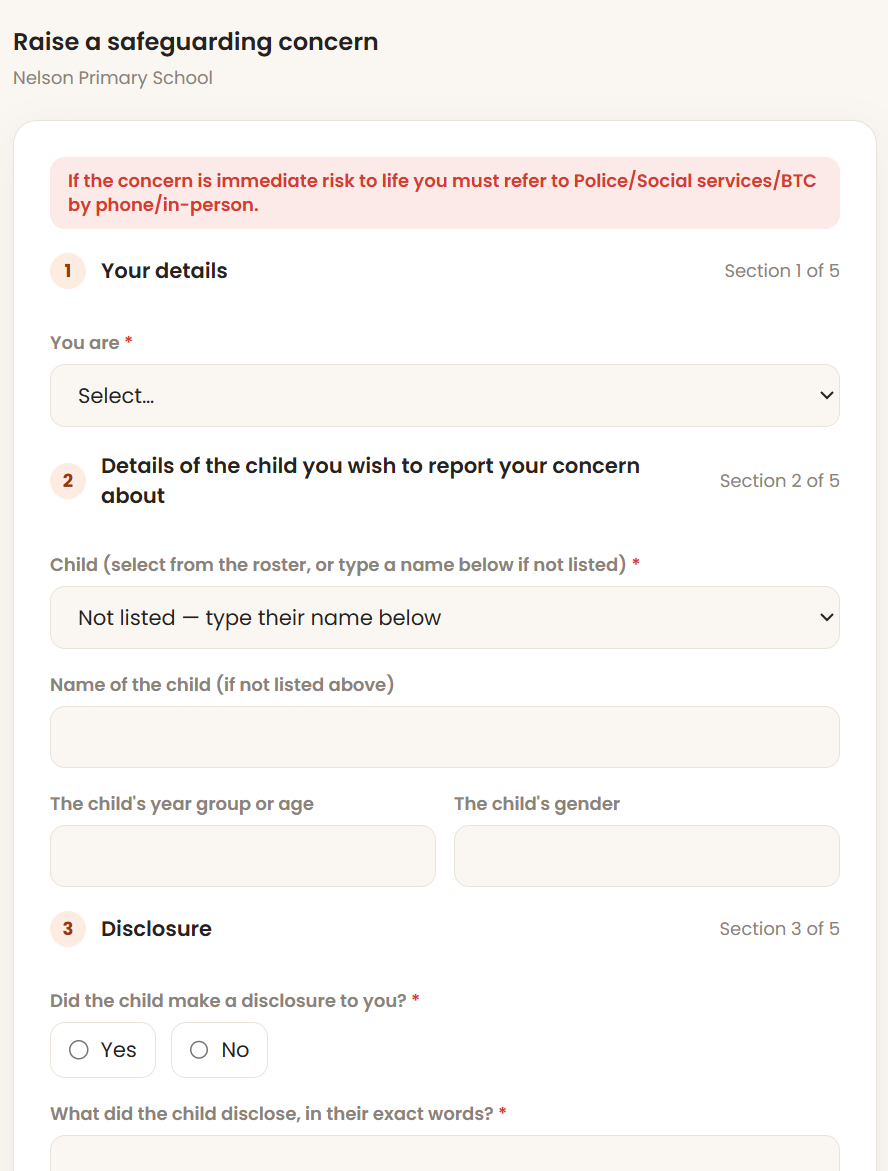
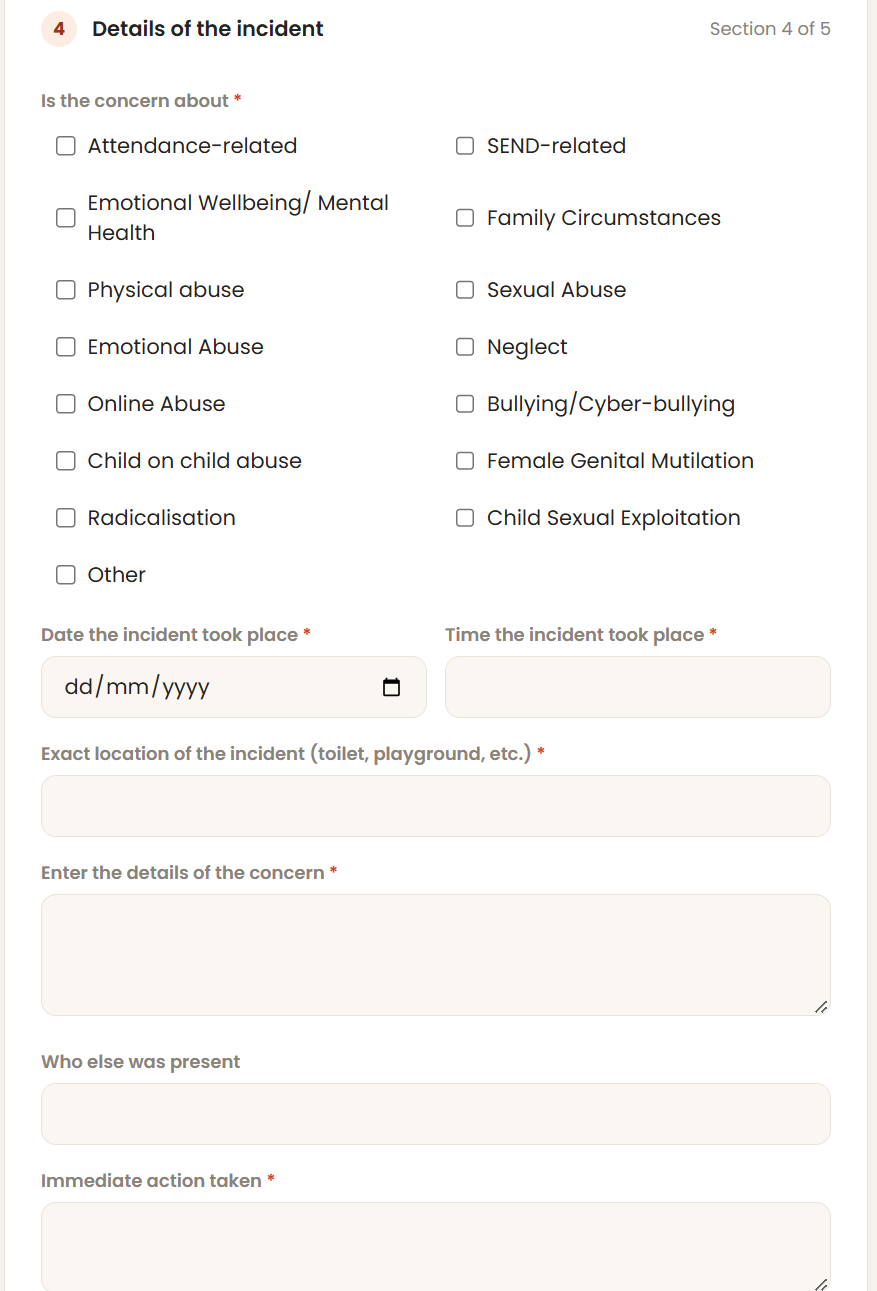
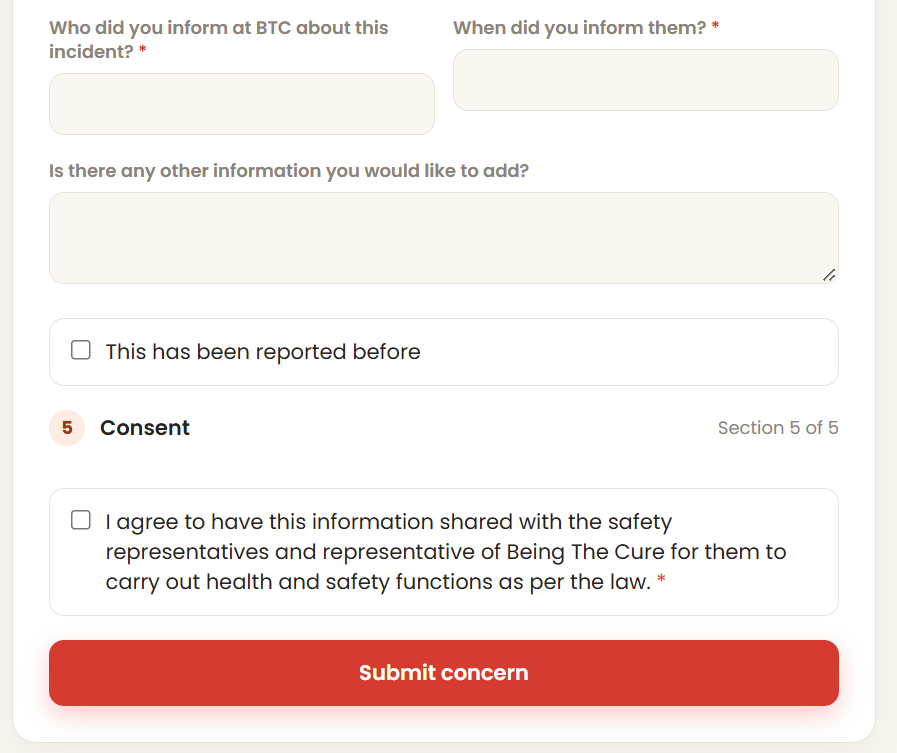
- Step 2Record the concern on the Saturday School app at saturdayschool.beingthecure.org, using the safeguarding concern form (see Figure 3).
- Step 3Record the concern on the same day, and always before you go home. The entry is timestamped and goes straight to the DSL. Reporting to the DSL in person and recording on the app are both required.
- Step 4The DSL will investigate and, where needed, refer to an external agency immediately, depending on the nature of the concern (see Figure 2).
- RecordThe DSL records the decision taken, the reason for it and any referral made against the same entry on the app, so that the whole history of the concern sits in one place.
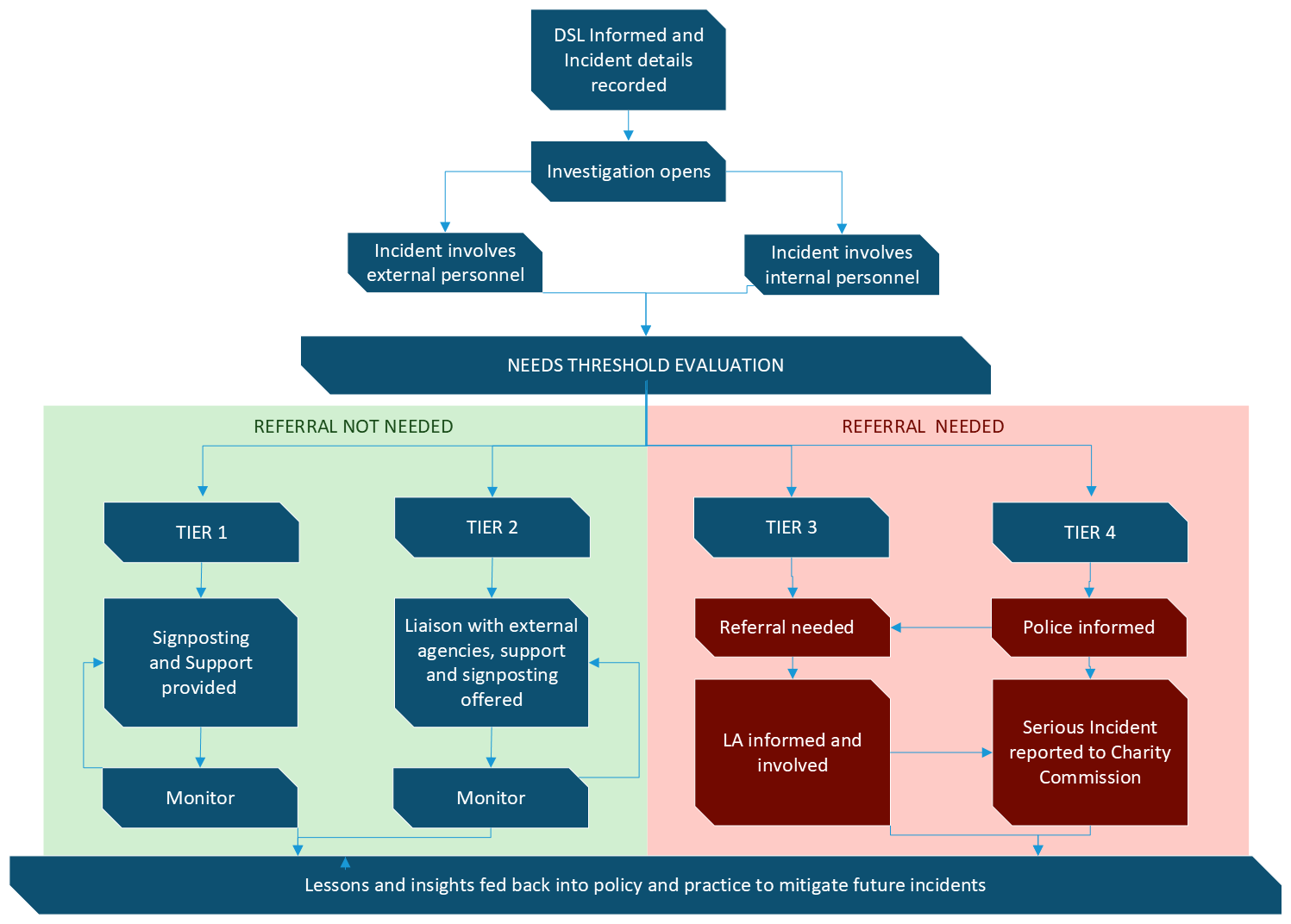
The needs threshold evaluation is conducted based on the criteria as per the Indicators of Need Matrix [Tier 1-4] of the Threshold Document outlined by the London Safeguarding Children Procedures. The DSL thereafter decides whether the incident needs a referral, and if so, in what capacity.
The DSL will report the incident to the Charity Commission via their online serious incident reporting portal.
Charity Commission - Serious Incident Report Form
This ‘Concern form’ is to be completed by BTC staff/volunteers and immediately sent to the BTC DSL via the email at safeguarding@beingthecure.org
This form must be sent to the BTC DSL immediately/on the same day of the concern being raised.
The concern form is completed on the Saturday School app at saturdayschool.beingthecure.org. It asks for: your name; the initials of the child; the year group or age; the gender; a summary of the concern in the child’s own words where they have spoken; what you saw or were told, and when; what you said or did in response; and whether anyone else was present. The entry is timestamped and goes straight to the DSL.
9.7Mandatory reporting of child sexual abuse
Part 5, Chapter 2 of the Crime and Policing Act 2026 (sections 85 to 94) creates a duty on any person aged 18 or over who is engaged in a relevant activity in England to notify the police or the local authority as soon as practicable where they have reason to suspect that a child sex offence has been, or may have been, committed. Relevant activity expressly includes regulated activity relating to children within the meaning of Part 1 of Schedule 4 to the Safeguarding Vulnerable Groups Act 2006. Section 92 creates a separate offence of preventing or deterring another person from complying with the duty, carrying a maximum of seven years’ imprisonment on indictment.
BTC adopts the following, as policy:
- Any member of staff, volunteer or trustee who has reason to suspect that a child sex offence has been or may have been committed must report it to the DSL immediately and, in any event, on the same day.
- The DSL will notify Newham MASH and, where a criminal offence is suspected, the police, as soon as practicable, and will record the time and content of the notification.
- No person at BTC may discourage, delay or prevent another person from making such a report. Doing so will be treated as gross misconduct and will itself be reported to the Charity Commission as a serious incident.
- This requirement is in addition to, and does not replace, the reporting routes set out elsewhere in this section.
The DSL will confirm the commencement position at each annual review and, once the duty is in force, this paragraph will be restated as a legal duty rather than as a policy commitment.
9.8Concerns about a staff member, supply teacher, volunteer, or contractor
If you have concerns about a member of staff or volunteer within BTC or a member of staff at the educational establishments you are visiting (supply teachers, volunteers, site or contractors), or an allegation is made about a member of BTC staff or volunteer or a member of staff at the educational establishments you are visiting (including a supply teacher, volunteer or contractor) posing a risk of harm to children, speak to the CEO of BTC as soon as possible.
If the concerns/allegations are about the CEO, speak to the safeguarding link trustee at safeguarding@beingthecure.org
The CEO/safeguarding link trustee will then follow the procedures set out in the Managing Allegations Against Staff, Volunteers and Trustees Policy, if appropriate.
If the concerns/allegations are about the Chair of the board of trustees or safeguarding link trustees, speak to the local authority designated officer (LADO).
Where you believe there is a conflict of interest in reporting a concern or allegation about a member of staff (including a supply teacher, volunteer, or contractor) to the CEO and/or to the safeguarding link trustee report it directly to the local authority designated officer (LADO).
9.9Allegations of abuse made against other children
We recognise that children are capable of abusing their peers. Abuse will never be tolerated or passed off as “banter”, “just having a laugh” or “part of growing up”, as this can lead to a culture of unacceptable behaviours and an unsafe environment for children.
We also recognise the gendered nature of child-on-child abuse. However, all child-on-child abuse is unacceptable and will be taken seriously.
Most cases of children hurting other children will be dealt with under BTC’s behaviour policy, but this child protection and safeguarding policy will apply to any allegations that raise safeguarding concerns. This might include where the alleged behaviour:
- Is serious, and potentially a criminal offence
- Could put children in the setting at risk
- Is violent
- Involves children being forced to use drugs or alcohol
- Involves sexual exploitation, sexual abuse, or sexual harassment, such as indecent exposure, sexual assault, up-skirting or sexually inappropriate pictures or videos (including the sharing of nudes and semi-nudes)
See Appendix 2 of this policy for more information about child-on-child abuse.
Procedures for dealing with allegations of Child-on-child abuse
If a child makes an allegation of abuse against another child:
You must record the allegation and tell the DSL but do not investigate it
The DSL will contact the local authority children’s social care team and follow its advice, as well as the police if the allegation involves a potential criminal offence
The DSL will put a risk assessment and support plan into place for all children involved (including the victim(s), the child(ren) against whom the allegation has been made and any others affected) with a named person they can talk to if needed.
The DSL will contact the children and adolescent mental health services (CAMHS), if appropriate
BTC staff must also report this to their DSL immediately following normal safeguarding reporting procedures (see figure 1, figure 2, and figure 3).
Creating a supportive environment and minimising the risk of child-on-child abuse
We recognise the importance of taking proactive action to minimise the risk of child-on-child abuse, and of creating a supportive environment where victims feel confident in reporting incidents.
To achieve this, we will work pro-actively with the staff of educational establishments we are visiting to:
- Challenge any form of derogatory or sexualised language or inappropriate behaviour between peers, including requesting or sending sexual images
- Be vigilant to issues that particularly affect different genders – for example, sexualised or aggressive touching or grabbing towards female children, and initiation or hazing type violence with respect to boys
- Ensure our curriculum helps to educate children about appropriate behaviour and consent
- Ensure children are able to easily and confidently report abuse using our reporting systems
- Ensure staff and volunteers reassure victims that they are being taken seriously
- Ensure staff and volunteers are trained to understand:
- How to recognise the indicators and signs of child-on-child abuse, and know how to identify it and respond to reports
- That even if there are no reports of child-on-child abuse, it does not mean it is not happening – staff and volunteers should maintain an attitude of “it could happen here”
- That if they have any concerns about a child’s welfare, they should act on them immediately rather than wait to be told, and that victims may not always make a direct report. For example:
- Children can show signs or act in ways they hope adults will notice and react to
- A friend may make a report
- A member of staff/volunteer may overhear a conversation
- A child’s behaviour might indicate that something is wrong
- That certain children may face additional barriers to telling someone because of their vulnerability, disability, gender, ethnicity and/or sexual orientation
- That a child harming a peer could be a sign that the child is being abused themselves, and that this would fall under the scope of this policy
- The important role they have to play in preventing child-on-child abuse and responding where they believe a child may be at risk from it
BTC staff and volunteers must also report this to their DSL immediately following normal safeguarding reporting procedures. The DSL of BTC may wish to refer to escalate.
9.10Sharing of nudes and semi-nudes (‘sexting’)
Your responsibilities when responding to an incident
If you are made aware of an incident involving the consensual or non-consensual sharing of nude or semi-nude images/videos (also known as ‘sexting’ or ‘youth produced sexual imagery’), you must report it to the DSL immediately.
This includes an image or video that has been digitally altered, and one that has been generated or manipulated using artificial intelligence, including a so-called deepfake. An AI-generated or altered nude or semi-nude image of a child is treated in exactly the same way as a photograph, and the prohibitions below apply to it in full. Creating or sharing such an image of a child is a criminal offence.
You must not:
- View, copy, print, share, store or save the imagery yourself, or ask a child to share or download it (if you have already viewed the imagery by accident, you must report this to the DSL)
- Delete the imagery or ask the child to delete it
- Ask the child(ren) who are involved in the incident to disclose information regarding the imagery (this is the DSL’s responsibility)
- Share information about the incident with other members of staff, the child(ren) it involves or their, or other, parents and/or carers
- Say or do anything to blame or shame any young people involved
You should explain that you need to report the incident, and reassure the child(ren) that they will receive support and help from the DSL
BTC staff and volunteers must also report this to their DSL immediately following normal safeguarding reporting procedures. The DSL may wish to refer to escalate.
Initial review meeting
Following a report of an incident, the DSL will hold an initial review meeting with appropriate staff – this may include the staff member who reported the incident and the safeguarding or leadership team that deals with safeguarding concerns. This meeting will consider the initial evidence and aim to determine:
Whether there is an immediate risk to child(s)
If a referral needs to be made to the police and/or children’s social care
What further information is required to decide on the best response
If there is a need to contact the child’s school or college for follow-up.
The DSL will make an immediate referral to police and/or children’s social care if:
The incident involves an adult
There is reason to believe that a young person has been coerced, blackmailed, or groomed, or if there are concerns about their capacity to consent (for example owing to special educational needs)
The DSL knows that the images or videos suggests the content depicts sexual acts which are unusual for the young person’s developmental stage, or are violent
The imagery involves sexual acts and any child in the images or videos is under 13
The DSL has reason to believe a child is at immediate risk of harm owing to the sharing of nudes and semi-nudes (for example, the young person is presenting as suicidal or self-harming)
If none of the above apply then the DSL, in consultation with the CEO and other members of staff as appropriate, may decide to respond to the incident without involving the police or children’s social care. The decision will be made and recorded in line with the procedures set out in this policy.
Section 10Online safety and the use of mobile technology
We recognise the importance of safeguarding children from potentially harmful and inappropriate online material, and we understand that technology is a significant component in many safeguarding and wellbeing issues.
To address this, BTC aims to:
- Have robust processes in place to ensure the online safety of children, staff, volunteers, and Trustees
- Protect and educate the whole BTC community in its safe and responsible use of technology, including mobile and smart technology (which we refer to as ‘mobile phones’)
- Set clear guidelines for the use of mobile phones for staff and volunteers.
- Establish clear mechanisms to identify, intervene in and escalate any incidents or concerns, where appropriate
- To speak with parents/carers about what their children access online
The 4 key categories of risk
Our approach to online safety is based on addressing the following categories of risk:
Content – being exposed to illegal, inappropriate, or harmful content, such as pornography, fake news, racism, misogyny, self-harm, suicide, anti-Semitism, radicalisation, and extremism
Contact – being subjected to harmful online interaction with other users, such as child-to-child pressure, commercial advertising and adults posing as children or young adults with the intention to groom or exploit them for sexual, criminal, financial or other purposes
Conduct – personal online behaviour that increases the likelihood of, or causes, harm, such as making, sending, and receiving explicit images (e.g., consensual and non-consensual sharing of nudes and semi-nudes and/or pornography), sharing other explicit images and online bullying; and
Commerce – risks such as online gambling, inappropriate advertising, phishing and/or financial scams
To meet our aims and address the risks above we will:
- Educate children about online safety as part of our curriculum. For example:
- The safe use of social media, the internet and technology
- Keeping personal information private
- How to recognise unacceptable behaviour online
- How to report any incidents of cyber-bullying, ensuring children are encouraged to do so, including where they are a witness rather than a victim.
- Train staff, as part of their induction, on safe internet use and online safeguarding issues including cyber-bullying and the risks of online radicalisation. All staff members will receive refresher training at least once each academic year.
- Make sure staff are aware of any restrictions placed on them with regards to the use of their mobile phone and cameras, for example that:
- Staff are allowed to bring their personal phones to BTC sites for their own use, but will limit such use to non-contact time when children are not present
- Staff will not take pictures or recordings of children on their personal phones or cameras
- Make all children, parents/carers, staff, volunteers and BTC members aware that they are expected to sign an agreement regarding the acceptable use of the internet in any educational establishment, use of the establishment ICT systems and use of their mobile and smart technology
- Carry out an annual review of our approach to online safety, supported by an annual risk assessment that considers and reflects the risks faced by our visits to educational establishments.
This section summarises our approach to online safety and mobile phone use. For comprehensive details about BTCs policy on online safety and the use of mobile phones, please refer to our online safety policy and mobile phone policy, which you can find on our website at www.beingthecure.org/policies
Section 11Children with special educational needs, disabilities or health issues
We recognise that children with special educational needs (SEN) or disabilities or certain health conditions can face additional safeguarding challenges. Additional barriers can exist when recognising abuse and neglect in this group, including:
- Assumptions that indicators of possible abuse such as behaviour, mood and injury relate to the child’s condition without further exploration
- Children being more prone to peer group isolation or bullying (including prejudice-based bullying) than other children
- The potential for children with SEN, disabilities or certain health conditions being disproportionally impacted by behaviours such as bullying, without outwardly showing any signs
- Communication barriers and difficulties in managing or reporting these challenges.
- Cognitive understanding – being unable to understand the difference between fact and fiction in online content and then repeating the content/behaviours in schools/colleges or the consequences of doing so.
Children who are lesbian, gay, bi-sexual, or trans (LGBT)
The fact that a child or young person may be LGBT is not in itself an inherent risk factor for harm. However, children who are LGBT can be targeted by other children. In some cases, a child who is perceived by other children to be LGBT (whether they are or not) can be just as vulnerable as children who identify as LGBT.
Risks can be compounded where children who are LGBT lack a trusted adult with whom they can be open. It is therefore vital that staff endeavour to reduce the additional barriers faced and provide a safe space for them to speak or shar their concerns with a member of staff.
BTC staff are always available to support children and ensure they have a trusted adult they can share any concerns with.
Children with a social worker
Children may need a social worker due to safeguarding or welfare needs. We recognise that a child’s experiences of adversity and trauma can leave them vulnerable to further harm as well as potentially creating barriers to attendance, learning, behaviour, and mental health.
The DSL will alert BTC staff to those children who are supported with social workers before the visit starts to help us protect vulnerable children.
11.1Looked-after and previously looked-after children
We will ensure that BTC staff and volunteers have the skills, knowledge and understanding to keep looked-after children and previously looked-after children safe. In particular, we will ensure that:
- Staff have relevant training and information about Looked-after and previously looked-after children and the importance of being vigilant in terms of safeguarding.
Section 12Complaints and concerns about BTC safeguarding policies
12.1Complaints against staff
Complaints against staff and volunteers that are likely to require a child protection investigation will be handled in accordance with our procedures for dealing with allegations of abuse made against staff (see the Managing Allegations Against Staff, Volunteers and Trustees Policy).
12.2Whistleblowing
Staff who have safeguarding concerns about another staff member and their behaviour towards or conduct towards a child must immediately inform the CEO of BTC. If the concern is about the CEO, you must immediately inform the Chair of the Trustees. Staff must consult the Whistleblowing policy for further details.
Section 13Record-keeping
We will hold records in line with our records retention schedule.
All safeguarding concerns, discussions, decisions made and the reasons for those decisions, must be recorded in writing. If you are in any doubt about whether to record something, discuss it with the DSL.
Records will include:
- A clear and comprehensive summary of the concern
- Details of how the concern was followed up and resolved
- A note of any action taken, decisions reached and the outcome
- Any non-confidential records will be readily accessible and available. Confidential information and records will be held securely electronically, and password protected. They will only be available to those who have a right or professional need to see them.
- Safeguarding records relating to individual children will be retained for a reasonable period of time after they have left the programme.
- Safeguarding records which contain information about allegations of sexual abuse will be retained for the Independent Inquiry into Child Sexual Abuse (IICSA), for the term of the inquiry.
In addition:
the Safer Recruitment and DBS Policy sets out our policy on record-keeping specifically with respect to recruitment and pre-appointment checks.
the Managing Allegations Against Staff, Volunteers and Trustees Policy sets out our policy on record-keeping with respect to allegations of abuse made against staff
Data protection, information sharing and complaints
Fear of breaching data protection law must never be a reason to withhold information that is needed to keep a child safe. The UK GDPR and the Data Protection Act 2018 permit the sharing of personal data, including special category data such as health and safeguarding information, where it is necessary for safeguarding purposes. If in doubt, staff and volunteers should share the concern with the DSL and let the DSL decide what is shared onward.
Recording concerns. Every safeguarding concern, disclosure and incident is recorded on the Saturday School app at saturdayschool.beingthecure.org. Every member of staff and every volunteer has an account and records concerns there directly — not on paper, not by email, and not by message to an individual.
A concern is recorded on the app on the same day, and always before the person goes home. Where a child is in immediate danger, act first — call 999 and tell the DSL — and record afterwards. The DSL records the decision taken, the reason for it, and any referral made, against the same entry, so that the whole history of a concern sits in one place.
Accidents and injuries are recorded on the same app, under the accident form. Where an accident and a safeguarding concern arise from the same event, both are completed.
Access to safeguarding records on the app is restricted to the DSL, the deputy DSL and the CEO. The app is the system of record; where anything is written down elsewhere in the moment, it is transferred to the app and the paper note is destroyed.
Complaints about BTC’s handling of personal data are made to the CEO, Vijith Vijay, at vijith@beingthecure.org, and are handled under the Data Protection Policy, not under this policy.
Where the London Borough of Newham serves a notice under section 436E of the Education Act 1996, inserted by section 38 of the Children’s Wellbeing and Schools Act 2026, requiring information about a child who is receiving out-of-school education, BTC will comply with that notice. Data protection is not a barrier to compliance with a statutory information notice. The CEO will keep a record of any such notice received and of the information supplied, and will report it to the next meeting of the Education and Safeguarding Committee.
Section 14Training
14.1All staff
All staff members will undertake safeguarding and child protection training at induction and annually thereafter, including on whistle-blowing procedures and online safety, to ensure they understand BTC’s safeguarding systems and their responsibilities, and can identify signs of possible abuse or neglect.
This training will be regularly updated and will:
- Be integrated, aligned, and considered as part of the whole organisations safeguarding approach and wider staff training.
- Be in line with advice from the 3 safeguarding partners
- Have a clear understanding of the needs of all children
All staff and volunteers will have training on the government’s anti-radicalisation strategy, Prevent (more details in Appendix 2 of this policy), to enable them to identify children at risk of being drawn into terrorism and to challenge extremist ideas.
Staff will also receive regular safeguarding and child protection updates, including on online safety, as required but at least annually (for example, through emails, e-bulletins, and staff meetings).
Volunteers will receive appropriate training, if applicable.
14.2The DSL and deputy/deputies
The DSL and deputy/deputies will undertake child protection and safeguarding training at least every 2 years. In addition, they will update their knowledge and skills at regular intervals and at least annually (for example, through e-bulletins, meeting other DSLs, or taking time to read and digest safeguarding developments). They will also undertake Prevent awareness training.
14.3Charity board members
All Trustees receive training about safeguarding, to make sure they have the knowledge and information needed to perform their functions and understand their responsibilities.
The safeguarding link trustee(s) may be required to act as the ‘case manager’ in the event that an allegation of abuse is made against the CEO, they receive training in managing allegations for this purpose.
14.4Recruitment – interview panels
At least one person conducting any interview for any post at BTC will have undertaken safer recruitment training. This will cover, as a minimum, the contents of Keeping Children Safe in Education 2026, and will be in line with local safeguarding procedures.
See the Safer Recruitment and DBS Policy for more information about our safer recruitment procedures.
Section 15Extended and off-site arrangements
All extended and off-site activities are subject to a risk assessment to satisfy health and safety and safeguarding requirements. Where extended activities are provided by and managed by BTC, our own child protection policy and procedures apply. If other organisations provide services or activities on our site on behalf of us, we will check that they have appropriate procedures in place, including safer recruitment procedures. When our children attend off-site activities, including day and residential visits and work-related activities, we will check that effective child protection arrangements are in place and risk assessments completed.
Section 16Links with other policies
This policy should be read alongside the following Being The Cure policies. All are published at:
https://www.beingthecure.org/policies
- Staff and Volunteer Code of Conduct
- Safer Recruitment and DBS Policy — which contains the safer recruitment procedure and the vetting requirements formerly reproduced at Appendix 2 of this policy
- Managing Allegations Against Staff, Volunteers and Trustees — which contains the procedure formerly reproduced at Appendix 3 of this policy, including low-level concerns
- Safeguarding Adults at Risk Policy
- Missing Child, Collection and Home Alone Policy
- Behaviour Policy
- Anti-Bullying and Harassment Policy
- Online Safety and Acceptable Use Policy
- Photography, Filming and Image Consent Policy
- First Aid, Medication and Allergy Management Policy
- Educational Visits Policy
- Complaints Policy
- Whistleblowing Policy
- Equality, Diversity and Inclusion Policy
- Data Protection Policy, and the Privacy Notices and Records Retention Policy
- Volunteering Policy
Appendix 1Types of abuse
Abuse, including neglect, and safeguarding issues are rarely standalone events that can be covered by one definition or label. In most cases, multiple issues will overlap.
Physical abuse may involve hitting, shaking, throwing, poisoning, burning or scalding, drowning, suffocating or otherwise causing physical harm to a child. Physical harm may also be caused when a parent or carer fabricates the symptoms of, or deliberately induces, illness in a child.
Emotional abuse is the persistent emotional maltreatment of a child such as to cause severe and adverse effects on the child’s emotional development. Some level of emotional abuse is involved in all types of maltreatment of a child, although it may occur alone.
Emotional abuse may involve:
- Conveying to a child that they are worthless or unloved, inadequate, or valued only insofar as they meet the needs of another person
- Not giving the child opportunities to express their views, deliberately silencing them or ‘making fun’ of what they say or how they communicate
- Age or developmentally inappropriate expectations being imposed on children. These may include interactions that are beyond a child’s developmental capability, as well as overprotection and limitation of exploration and learning, or preventing the child participating in normal social interaction
- Seeing or hearing the ill-treatment of another
- Serious bullying (including cyber-bullying), causing children frequently to feel frightened or in danger, or the exploitation or corruption of children
Sexual abuse involves forcing or enticing a child or young person to take part in sexual activities, not necessarily involving a high level of violence, whether or not the child is aware of what is happening. The activities may involve:
- Physical contact, including assault by penetration (for example rape or oral sex) or non-penetrative acts such as masturbation, kissing, rubbing and touching outside of clothing
- Non-contact activities, such as involving children in looking at, or in the production of, sexual images, watching sexual activities, encouraging children to behave in sexually inappropriate ways, or grooming a child in preparation for abuse (including via the internet)
Sexual abuse is not solely perpetrated by adult males. Women can also commit acts of sexual abuse, as can other children. It is also important to ensure we understand the harm caused by Intra-familial child sexual abuse and ensure necessary support is in place for siblings following incidents.
Neglect is the persistent failure to meet a child’s basic physical and/or psychological needs, likely to result in the serious impairment of the child’s health or development. Neglect may occur during pregnancy as a result of maternal substance abuse.
Once a child is born, neglect may involve a parent or carer failing to:
- Provide adequate food, clothing, and shelter (including exclusion from home or abandonment)
- Protect a child from physical and emotional harm or danger
- Ensure adequate supervision (including the use of inadequate caregivers)
- Ensure access to appropriate medical care or treatment
- It may also include neglect of, or unresponsiveness to, a child’s basic emotional needs.
Appendix 2Specific safeguarding issues
Child criminal exploitation
Child criminal exploitation (CCE) is a form of abuse where an individual or group takes advantage of an imbalance of power to coerce, control, manipulate or deceive a child into criminal activity, in exchange for something the victim needs or wants, and/or for the financial or other advantage of the perpetrator or facilitator, and/or through violence or the threat of violence.
The abuse can be perpetrated by males or females, and children or adults. It can be a one-off occurrence or a series of incidents over time and range from opportunistic to complex organised abuse.
The victim can be exploited even when the activity appears to be consensual. It does not always involve physical contact and can happen online. For example, young people may be forced to work in cannabis factories, coerced into moving drugs or money across the country (county lines), forced to shoplift or pickpocket, or to threaten other young people.
Indicators of CCE can include a child:
- Appearing with unexplained gifts or new possessions
- Associating with other young people involved in exploitation
- Suffering from changes in emotional wellbeing
- Misusing drugs and alcohol
- Going missing for periods of time or regularly coming home late
- Regularly missing school or education
- Not taking part in education
If a member of staff suspects CCE, they will discuss this with the DSL. The DSL will trigger the local safeguarding procedures, including a referral to the local authority’s children’s social care team and the police, if appropriate.
Child sexual exploitation
Child sexual exploitation (CSE) is a form of child sexual abuse where an individual or group takes advantage of an imbalance of power to coerce, manipulate or deceive a child into sexual activity, in exchange for something the victim needs or wants and/or for the financial advantage or increased status of the perpetrator or facilitator. It may, or may not, be accompanied by violence or threats of violence.
The abuse can be perpetrated by males or females, and children or adults. It can be a one-off occurrence or a series of incidents over time and range from opportunistic to complex organised abuse.
The victim can be exploited even when the activity appears to be consensual. Children or young people who are being sexually exploited may not understand that they are being abused. They often trust their abuser and may be tricked into believing they are in a loving, consensual relationship.
CSE can include both physical contact (penetrative and non-penetrative acts) and non-contact sexual activity. It can also happen online. For example, young people may be persuaded or forced to share sexually explicit images of themselves, have sexual conversations by text, or take part in sexual activities using a webcam. CSE may also occur without the victim’s immediate knowledge, for example through others copying videos or images.
In addition to the CCE indicators above, indicators of CSE can include a child:
- Having an older boyfriend or girlfriend
- Suffering from sexually transmitted infections or becoming pregnant
If a member of staff suspects CSE, they will discuss this with the DSL. The DSL will trigger the local safeguarding procedures, including a referral to the local authority’s children’s social care team and the police, if appropriate.
Domestic Abuse
Children can witness and be adversely affected by domestic abuse and/or violence at home where it occurs between family members. In some cases, a child may blame themselves for the abuse or may have had to leave the family home as a result.
Types of domestic abuse include intimate partner violence, abuse by family members, teenage relationship abuse and child/adolescent to parent violence and abuse. Anyone can be a victim of domestic abuse, regardless of gender, age, ethnicity, socioeconomic status, sexuality or background, and domestic abuse can take place inside or outside of the home.
Domestic abuse can encompass a wide range of behaviours and may be a single incident or a pattern of incidents. DA can be, but not limited to:
- Psychological
- Physical
- Sexual
- Financial
- Emotional
Children can be victims of domestic abuse. They can may see, hear or experience the effects of abuse at home and/or suffer domestic abuse in their own intimate relationships (teenage relationship abuse). All of this can have a detrimental and long terms impact on their health, well-being, development and ability to learn.
If police are called to an incident of domestic abuse and any children in the household have experienced the incident, the police will inform the key adult at BTC (usually the designated safeguarding lead) before the child or children arrive at the setting the following day.
The DSL will provide support according to the child’s needs and update records about their circumstances.
Homelessness
Being homeless or being at risk of becoming homeless presents a real risk to a child’s welfare.
The DSL and deputy/deputies will be aware of contact details and referral routes in to the local housing authority so they can raise/progress concerns at the earliest opportunity (where appropriate and in accordance with local procedures).
Where a child has been harmed or is at risk of harm, the DSL will also make a referral to children’s social care.
So-called ‘honour-based’ abuse (including FGM and forced marriage)
So-called ‘honour-based’ abuse (HBA) encompasses incidents or crimes committed to protect or defend the honour of the family and/or community, including FGM, forced marriage, and practices such as breast ironing.
Abuse committed in this context often involves a wider network of family or community pressure and can include multiple perpetrators.
All forms of HBA are abuse and will be handled and escalated as such. All staff will be alert to the possibility of a child being at risk of HBA or already having suffered it. If staff have a concern, they will speak to the DSL, who will activate local safeguarding procedures.
FGM
The DSL will make sure that staff have access to appropriate training to equip them to be alert to children affected by FGM or at risk of FGM.
Section 9.3 of this policy sets out the procedures to be followed if a staff member discovers that an act of FGM appears to have been carried out or suspects that a child is at risk of FGM.
Indicators that FGM has already occurred include:
- A child confiding in a professional that FGM has taken place
- A mother/family member disclosing that FGM has been carried out
- A family/child already being known to social services in relation to other safeguarding issues
- A girl:
- Having difficulty walking, sitting, or standing, or looking uncomfortable
- Finding it hard to sit still for long periods of time (where this was not a problem previously)
- Spending longer than normal in the toilet or toilet due to difficulties urinating
- Having frequent urinary, menstrual or stomach problems
- Avoiding physical exercise or missing PE
- Being repeatedly absent from school, or absent for a prolonged period
- Demonstrating increased emotional and psychological needs – for example, withdrawal or depression, or significant change in behaviour
- Being reluctant to undergo any medical examinations
- Asking for help, but not being explicit about the problem
- Talking about pain or discomfort between her legs
Potential signs that a child may be at risk of FGM include:
- The girl’s family having a history of practising FGM (this is the biggest risk factor to consider)
- FGM being known to be practised in the girl’s community or country of origin
- A parent or family member expressing concern that FGM may be carried out
- A family not engaging with professionals (health, education or other) or already being known to social care in relation to other safeguarding issues
- A girl:
- Having a mother, older sibling or cousin who has undergone FGM
- Having limited level of integration within UK society
- Confiding to a professional that she is to have a “special procedure” or to attend a special occasion to “become a woman”
- Talking about a long holiday to her country of origin or another country where the practice is prevalent, or parents/carers stating that they or a relative will take the girl out of the country for a prolonged period
- Requesting help from a teacher or another adult because she is aware or suspects that she is at immediate risk of FGM
- Talking about FGM in conversation – for example, a girl may tell other children about it (although it is important to take into account the context of the discussion)
- Being unexpectedly absent from school
- Having sections missing from her ‘red book’ (child health record) and/or attending a travel clinic or equivalent for vaccinations/anti-malarial medication
The above indicators and risk factors are not intended to be exhaustive.
Forced marriage
Forcing a person into marriage is a crime. A forced marriage is one entered into without the full and free consent of one or both parties and where violence, threats, or any other form of coercion is used to cause a person to enter into a marriage. Threats can be physical or emotional and psychological.
Staff will receive training around forced marriage and the presenting symptoms. We are aware of the ‘one chance’ rule, i.e., we may only have one chance to speak to the potential victim and only one chance to save them.
If a member of staff suspects that a child is being forced into marriage, they will speak to the child about their concerns in a secure and private place. They will then report this to the DSL.
The DSL will:
- Speak to the child about the concerns in a secure and private place
- Activate the local safeguarding procedures and refer the case to the local authority’s designated officer
- Seek advice from the Forced Marriage Unit on 020 7008 0151 or fmu@fco.gov.uk
- Refer the child to an education welfare officer, pastoral tutor, learning mentor, or school counsellor, as appropriate
Preventing radicalisation
Radicalisation refers to the process by which a person comes to support terrorism and extremist ideologies associated with terrorist groups
Extremism is vocal or active opposition to fundamental British values, such as democracy, the rule of law, individual liberty, and mutual respect and tolerance of different faiths and beliefs. This also includes calling for the death of members of the armed forces
Terrorism is an action that:
- Endangers or causes serious violence to a person/people.
- Causes serious damage to property; or
- Seriously interferes or disrupts an electronic system
The use or threat of terrorism must be designed to influence the government or to intimidate the public and is made for the purpose of advancing a political, religious, or ideological cause.
Educational institutions have a duty to prevent children from being drawn into terrorism. The DSL and all other staff Including trustees will undertake Prevent awareness training and make sure that staff have access to appropriate training to equip them to identify children at risk. When a new Individual Is Inducted or when a new version of the course Is released, the training will be carried out and stored no the SCR.
We will assess the risk of children in our settings being drawn into terrorism. This assessment will be based on an understanding of the potential risk in our local area, in collaboration with our local safeguarding partners and local police force.
We will ensure that suitable internet filtering is in place and equip our children to stay safe online at our sites..
There is no single way of identifying an individual who is likely to be susceptible to an extremist ideology. Radicalisation can occur quickly or over a long period.
Staff will be alert to changes in children’ behaviour.
The government website Educate Against Hate and charity NSPCC say that signs that a child is being radicalised can include:
- Refusal to engage with, or becoming abusive to, peers who are different from themselves
- Becoming susceptible to conspiracy theories and feelings of persecution
- Changes in friendship groups and appearance
- Rejecting activities, they used to enjoy
- Converting to a new religion
- Isolating themselves from family and friends
- Talking as if from a scripted speech
- An unwillingness or inability to discuss their views
- A sudden disrespectful attitude towards others
- Increased levels of anger
- Increased secretiveness, especially around internet use
- Expressions of sympathy for extremist ideologies and groups, or justification of their actions
- Accessing extremist material online, including on Facebook or Twitter
- Possessing extremist literature
- Being in contact with extremist recruiters and joining, or seeking to join, extremist organisations
Children who are at risk of radicalisation may have low self-esteem or be victims of bullying or discrimination. It is important to note that these signs can also be part of normal teenage behaviour – staff should have confidence in their instincts and seek advice if something feels wrong.
If staff are concerned about a child, they will follow our procedures set out in section 9.4 of this policy, including discussing their concerns with the DSL.
Staff should always take action if they are worried.
Further information on the BTC’s measures to prevent radicalisation are set out in other policies and procedures.
Child-on-Child Abuse (previously known as Peer-on-Peer)
Child-on-Child abuse is when children abuse other children. This type of abuse can take place inside and outside of the settings and online. It is essential that all victims are reassured that they are being taken seriously regardless of how long it has taken them to come forward and they will be supported and kept safe. It is also important to explain that the law is in place to protect children rather than criminalise them. This should be explained in a way that avoids alarming or distressing them.
Child-on-Child abuse is most likely to include, but may not be limited to:
- Bullying (including cyber-bullying, prejudice-based and discriminatory bullying)
- Abuse in intimate personal relationships between peers
- Physical abuse such as hitting, kicking, shaking, biting, hair pulling, or otherwise causing physical harm (this may include an online element which facilitates, threatens and/or encourages physical abuse)
- Sexual violence, such as rape, assault by penetration and sexual assault (this may include an online element which facilitates, threatens and/or encourages sexual violence)
- Sexual harassment, such as sexual comments, remarks, jokes, and online sexual harassment, which may be standalone or part of a broader pattern of abuse
- Causing someone to engage in sexual activity without consent, such as forcing someone to strip, touch themselves sexually, or to engage in sexual activity with a third party
- Consensual and non-consensual sharing of nudes and semi nudes images and/or videos (also known as sexting or youth produced sexual imagery)
Upskirting, which typically involves taking a picture under a person’s clothing without their permission, with the intention of viewing their genitals or buttocks to obtain sexual gratification, or cause the victim humiliation, distress, or alarm
Initiation/hazing type violence and rituals (this could include activities involving harassment, abuse or humiliation used as a way of initiating a person into a group and may also include an online element)
Where children abuse their peers online, this can take the form of, for example, abusive, harassing, and misogynistic messages; the non-consensual sharing of indecent images, especially around chat groups; and the sharing of abusive images and pornography, to those who don't want to receive such content.
If staff have any concerns about child-on-child abuse, or a child makes a report to them, they will follow the procedures set out in section 9 of this policy, and in particular section 9.9.
Sexual violence and sexual harassment between children in educational settings
Sexual violence and sexual harassment can occur:
- Between 2 children of any age and sex
- Through a group of children sexually assaulting or sexually harassing a single child or group of children
- Online and face to face (both physically and verbally)
Sexual violence and sexual harassment exist on a continuum and may overlap.
Children who are victims of sexual violence and sexual harassment will likely find the experience stressful and distressing. This will, in all likelihood, adversely affect their educational attainment and will be exacerbated if the alleged perpetrator(s) attends the same school.
If a victim reports an incident, it is essential that staff make sure they are reassured that they are being taken seriously and that they will be supported and kept safe. A victim should never be given the impression that they are creating a problem by reporting sexual violence or sexual harassment. Nor should a victim ever be made to feel ashamed for making a report.
Some groups are potentially more at risk. Evidence shows that girls, children with SEN and/or disabilities, and lesbian, gay, bisexual and transgender (LGBT) children are at greater risk.
Staff should be aware of the importance of:
- Challenging inappropriate behaviours
- Making clear that sexual violence and sexual harassment is not acceptable, will never be tolerated and is not an inevitable part of growing up
- Challenging physical behaviours (potentially criminal in nature), such as grabbing bottoms, breasts, and genitalia, pulling down trousers, flicking bras and lifting up skirts. Dismissing or tolerating such behaviours risks normalising them
If staff have any concerns about sexual violence or sexual harassment, or a child makes a report to them, they will follow the procedures set out in section 9 of this policy, as appropriate. In particular, sections 9.9 and 9.10 set out more detail about our approach to this type of abuse.
Serious violence
Indicators which may signal that a child is at risk from, or involved with, serious violent crime may include:
- Increased absence from the setting
- Change in friendships or relationships with older individuals or groups
- Significant decline in performance
- Signs of self-harm or a significant change in wellbeing
- Signs of assault or unexplained injuries
- Unexplained gifts or new possessions (this could indicate that the child has been approached by, or is involved with, individuals associated with criminal networks or gangs and may be at risk of criminal exploitation (see above))
Risk factors which increase the likelihood of involvement in serious violence include:
- Being male
- Having been frequently absent or permanently excluded from school or from our setting
- Having experienced child maltreatment
- Having been involved in offending, such as theft or robbery
Staff will be aware of these indicators and risk factors. If a member of staff has a concern about a child being involved in, or at risk of, serious violence, they will report this to the DSL.
Appendix 3Supervision of toilets and intimate care
Children five years of age and younger should use a classroom toilet if one is available. If a classroom toilet is not available, workers should escort a group of children to the hallway toilet. They should always go in a group, never taking a child to the toilet alone. The workers should check the toilet first to make sure that it is empty, and then allow the children inside. The workers should then remain outside the toilet door and escort the children back to the classroom. If a child is taking longer than seems necessary, the worker should open the toilet door and call the child's name. If a child requires assistance, the workers should prop open the toilet door, and leave the stall door open as they assist the child.
For children between the ages of five and eight, at least one adult male should take boys to the toilet and at least one adult female should take girls. The worker should check the toilet first to make sure that the toilet is empty, and then allow the children inside. The worker should then remain outside the toilet door and escort the children back to the classroom.
For the protection of all, workers should never be alone with a child in a toilet with the door closed and never be in a closed toilet stall with a child. Parents are strongly encouraged to have their children visit the toilet prior to each class.
Version history
- Version 5.0September 2026· Education & Safeguarding Committee
Annual review. Updated for Keeping Children Safe in Education 2026 and Working Together to Safeguard Children 2026. Removal of the DBS supervision exemption from 1 September 2026. Mandatory reporting of child sexual abuse adopted in advance of commencement. Data protection complaints duty under section 164A. Ofsted registration position recorded. Saturday School app adopted as the record for concerns and accidents.
- Version 4.0September 2025· Education & Safeguarding Committee
Annual review
- Version 3.0August 2024· Education & Safeguarding Committee
Annual review
- Version 2.0August 2023· Full board
Annual review
- Version 1.0September 2022· Full board
First adopted
Questions about this policy?
Contact us at info@beingthecure.org. If a child is in immediate danger, call 999.
Being The Cure is a registered charity in England and Wales (No. 1188077). This page is the published version of the Safeguarding and Child Protection Policy 2026–27.